

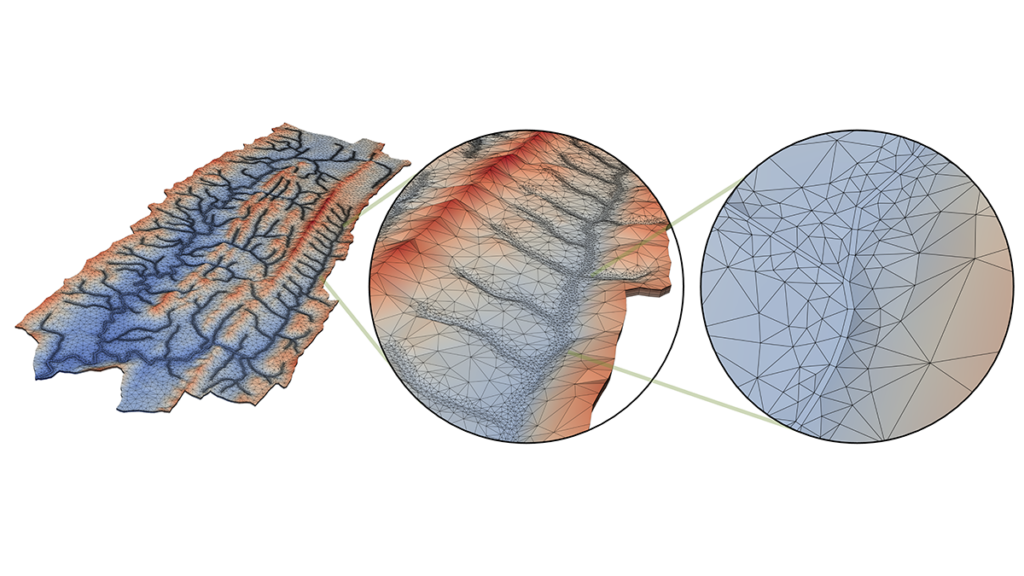
Stream networks are highly dynamic, constantly breathing by contraction and expansion, resulting in changing stream lengths. This is highly relevant for nutrient transport and greenhouse gas emissions. The interconnection of stream discharge and stream length, also termed elasticity, has been determined by measurements in small catchments experimentally and extrapolated by applying empirical power law models.
Rathore et al. [2026] demonstrate the limits of these laws using integrating modeling and a unique observational dataset. They also propose a novel asynchronous peak scaling approach which appears to be universal and provides a robust framework across scales from small to large watersheds. More importantly, the authors are able to mechanistically explain their findings from the physics-based simulations, which is highly satisfactory and lends confidence in the results.
Citation: Rathore, S. S., Gomez‐Velez, J. D., Herndon, E. M., & Painter, S. L. (2026). Hysteretic dynamics of stream network expansion and contraction revealed through high‐resolution integrated hydrological modeling. Water Resources Research , 62, e2025WR042993. https://doi.org/10.1029/2025WR042993
