

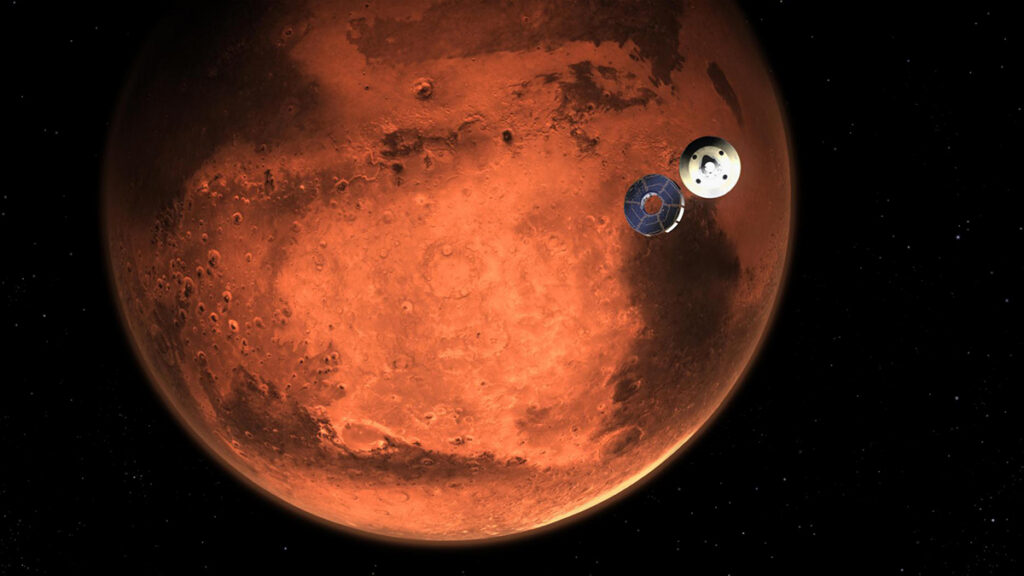
Since 2021, the Mars Perseverance rover has been roaming Jezero Crater, gathering details about the Red Planet’s geology and hints about its past. On its journey, the rover took close-up images of the Séítah formation, a nearly 4-billion-year-old layer of rock at the base of the crater.
A new study published in Communications Earth and Environment posits an explanation for how this rock layer formed, giving researchers a better glimpse into Mars’s history and geology and even the extent to which it could have hosted ancient life.
The results are also encouraging to scientists attempting to model planetary histories using information from Earth, said Lionel Wilson , a planetary scientist at Lancaster University in the United Kingdom who was not involved in the new study. The research “suggests that the long-term evolution of the mantles of Earth and Mars are not enormously different,” he said.
Previous research indicated that the Séítah formation was made of an olivine-rich type of rock called komatiite. On early Earth, komatiites formed from runny, low-viscosity lavas that flowed “almost like water,” forming lava lakes, said Adrian Brown , a planetary scientist at Plancius Research and lead author of the new paper. But Mars has a cooler interior that would, theoretically, make the formation of olivine more difficult.
In other words, the discovery of large grains of olivine on Mars was unusual.
