

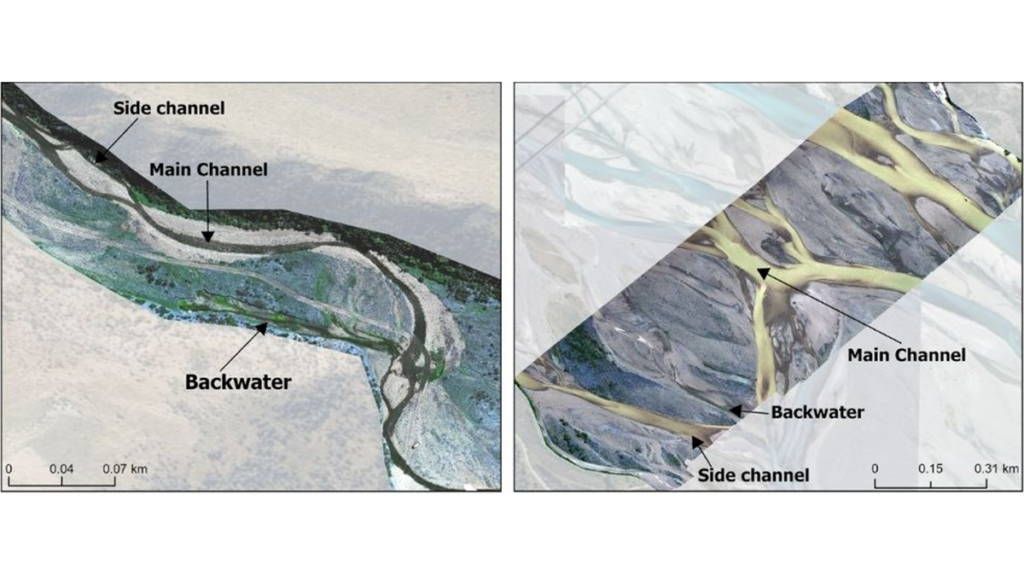
Rivers are important sources of greenhouse gases, including nitrous oxide (N 2 O), a powerful gas that contributes to climate warming. Although excess nitrogen from agriculture and urban areas can increase N 2 O production, the amount released also depends on how water moves through a river.
Braided rivers, which consist of multiple channels that split and rejoin, are particularly complex, yet their contribution to greenhouse gas emissions has received little attention.
By studying eight braided rivers in New Zealand, Arar et al. [2026] found that smaller, hill-fed rivers released more N 2 O than larger, faster-flowing alpine rivers, and that emissions varied considerably among channels within the same river. In particular, slow-moving backwaters were hotspots of N 2 O accumulation and release, likely because they provide conditions that favor its production and buildup.
Nitrogen availability was the strongest predictor of N 2 O concentrations, while water temperature also influenced patterns, particularly during winter. These findings reveal how differences in river flow and channel structure can influence greenhouse gas emissions, suggesting that overlooking smaller channels and backwaters could lead to underestimating the contribution of braided rivers to global N 2 O emissions.
Citation: Arar, M. I., Clough, T. J., Eyre, B. D., & Wells, N. S. (2026). Nitrous oxide accumulation in braided rivers is controlled by interactions between seasons, nitrate availability, and flow. Journal of Geophysical Research: Biogeosciences , 131, e2026JG010538. https://doi.org/10.1029/2026JG010538


